Frequently asked questions about Magnic Light
Here you will find answers about compatibility, how it works, installation, light output, durability and approval of Magnic Light.
Which Magnic Light fits my bicycle?
Will Magnic Light fit my bicycle?
In most cases, yes, provided there is a suitable mounting position and a conductive aluminium rim. The decisive factors are the brake type, rim and the distance between rim and fork or frame.
Which version do I need for rim brakes?
For road-bike, V-brake and cantilever rim brakes, the usual choice is Magnic Microlights .
Which version do I need for disc brakes?
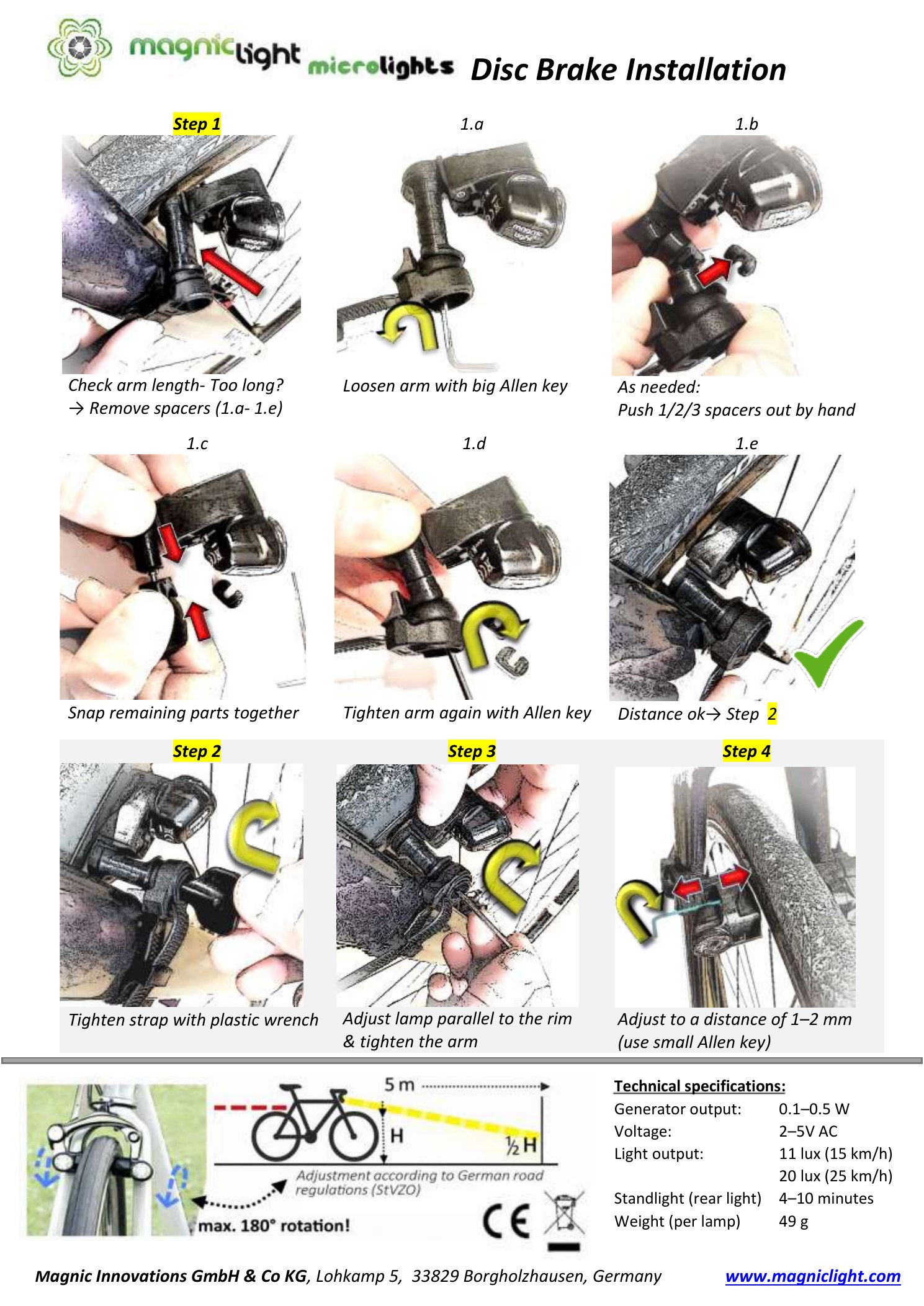
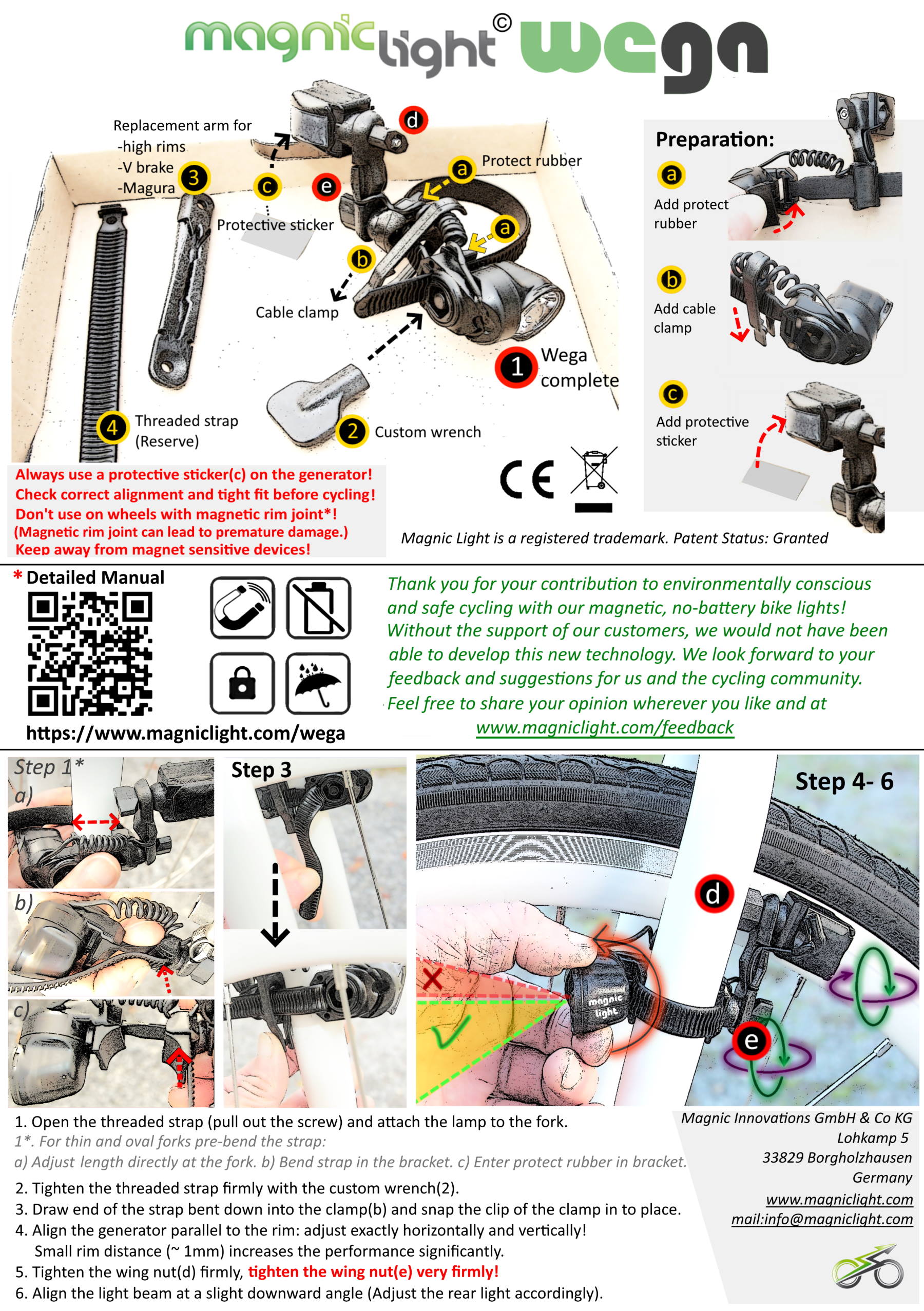
For disc brakes, either Microlights Disc or Wega can be suitable. Microlights Disc is particularly suited to compact installation spaces; Wega is designed for larger distances between rim and fork or frame.
What is the difference between Microlights Disc and Wega?
With Microlights Disc, generator and light are mounted compactly together directly at the rim. With Wega, generator and light are separated and connected by a cable. Wega is therefore particularly suitable for wide forks and larger clearances, for example on mountain bikes. Wega lights can also be used for special solutions, such as bicycle trailers.
Does Magnic Light work with carbon rims?
No. A pure carbon rim does not work. Magnic Light requires an electrically conductive rim area, typically aluminium.
Does it work with carbon rims that have an aluminium braking surface?
Yes, provided there is a sufficiently wide conductive aluminium ring in the correct position.
Does Magnic Light work with disc brakes?
Yes. Microlights Disc and Wega are designed specifically for this.
Does Magnic Light work on a road bike?
Yes. The compact dimensions and low weight are particularly attractive for road bikes.
Does Magnic Light work on gravel bikes?
Generally yes. The key factors are rim material and the available space at the fork and rear triangle.
Does Magnic Light work on a mountain bike?
Generally yes. With wide forks or larger clearances, Wega is often the more suitable solution.
Does Magnic Light work with small wheels, e.g. 16 or 20 inches?
Yes, Magnic Light also works with small wheels. For use in accordance with the German StVZO, additional legal requirements may have to be observed, particularly regarding minimum mounting height.
Can I send you a photo of my bicycle and ask which model fits?
Yes. Ideally send photos of the rim, fork and rear triangle – from the side and diagonally from the front or rear. We can then usually assess quickly which version is suitable.
How does Magnic Light work?
How can Magnic Light generate electricity without touching the rim?
A rotating magnetic field in the generator creates eddy currents in the passing conductive aluminium rim. Their magnetic field in turn acts back on the generator and sets its magnetic rotor in motion. This generates electrical energy – contactlessly.
Are magnets required in the rim?
No. No magnets are attached to the rim.
Do I need a dynamo?
Magnic Light is itself a contactless generator. A conventional sidewall or hub dynamo is not required.
Do I need a rechargeable battery?
No. The energy is generated while riding.
Do I need batteries?
No.
Does Magnic Light need to be charged?
No.
Why is aluminium particularly suitable?
The eddy-current principle requires an electrically conductive material. Aluminium rims are particularly well suited and are the intended standard solution. Steel rims can also react in principle, but their magnetic properties make them less suitable.
Does the generator touch the rim?
No. A small air gap remains between the generator and the rim.
Does Magnic Light slow the bicycle down?
All energy generation requires power. However, the power taken for the bicycle lighting is very small. In addition, Magnic Light has no mechanical friction from a roller rubbing on the tyre or rim.
Is this a perpetual-motion machine?
No. The electrical energy comes from the bicycle's kinetic energy. Magnic Light simply uses a different generator principle from conventional bicycle dynamos.
Why does something rotate inside the generator even though nothing touches the rim?
The interaction between the rotor's magnetic field and the eddy currents generated in the aluminium rim creates torque.
Where does the energy come from?
From the bicycle's kinetic energy – via electromagnetic eddy currents in the aluminium rim.
Why has nobody done this before?
The underlying physical principle of eddy currents has been known for a long time. The challenge is to use it to develop a small, efficient generator suitable for bicycles.
Is any special part installed in the rim?
No.
Light & performance
How bright is Magnic Light?
Depending on speed, one Magnic Light lamp reaches about 10–20 lux.
Is Magnic Light as bright as a powerful rechargeable bicycle light?
Magnic Light follows a different concept: permanently available lighting without charging and without a battery. Very powerful rechargeable headlights can achieve substantially higher light output.
At what speed does Magnic Light start to light up?
From about 3–4 km/h the lighting already starts to work. As speed increases, light output initially continues to rise.
Does the light keep getting brighter at high speed?
Up to about 50 km/h light output increases with speed. Above that, it rises only slightly.
Do the rim-brake Microlights have a brake-light effect?
Yes. When braking, rim and generator move closer together. Generator output and therefore brightness increase immediately. This creates a clearly visible brake-light effect for following traffic and when riding in a group.
This effect applies to Microlights mounted on the rim brake. It does not occur with Microlights Disc or Wega because these systems are not mounted on the rim brake.
Does the front light have a standlight?
No.
Does the rear light have a standlight?
Yes. The rear light has a standlight function using an electrolytic capacitor and continues to shine for several minutes after stopping.
How long does the rear standlight last?
Typically about 4–10 minutes, depending on the previous riding time and operating conditions.
Why is there no front standlight?
Implementing a suitable standlight for the front light is technically more complex than for the rear light. A front standlight function is under development.
Installation & riding feel
Can I install Magnic Light myself?
Yes. The systems are designed for self-installation.
Do I need special tools?
No. The tools needed for the respective installation are supplied, or standard bicycle tools are sufficient.
How precisely must the distance to the rim be adjusted?
With Microlights, the distance is automatically readjusted by a sliding mechanism. In general, the generator should run as close to the rim as possible without touching it continuously. A small, even air gap ensures optimum performance. Details are provided in the relevant installation guide.
What happens if the gap is too large?
Generator output then drops and the light may be dimmer or may only work reliably at higher speed.
What happens if Magnic Light touches the rim?
Continuous contact should be avoided where possible. The protective stickers supplied and pre-installed on Microlights are made of ultra-high-molecular-weight polyethylene, are highly abrasion-resistant and low-friction, and protect the housing during occasional contact.
With Microlights, the distance is also automatically readjusted as the brake pad wears: the generator is moved further outwards.
Can I install Magnic Light on the left or right side?
Depending on the product and mounting position, suitable versions and installation options are available.
Can I use the front and rear lights individually?
Yes.
Can I install only one rear light?
Yes.
Can I use two front lights or two rear lights?
Technically, several independent Magnic Light modules are possible. For road use, the applicable approval requirements must be observed.
Is Magnic Light noisy?
When installed correctly, Magnic Light operates very quietly. Because no friction wheel touches the rim, there is no typical sidewall-dynamo noise.
Can you feel resistance while riding?
There is physical resistance, but it is so small that it is practically imperceptible while riding. Magnic Light has also been used in racing. The power loss per light is below one watt and therefore very low.
Can the magnetic generator magnetise the rim?
No. An aluminium rim is not permanently magnetised by it.
Weather, everyday use & durability
Can I use Magnic Light in the rain?
Yes. The system is designed for bicycle use and riding in all weather conditions.
Is Magnic Light waterproof?
Magnic Light is rated IPX6 for protection against powerful water jets and is designed for normal bicycle use in rain.
Can I use Magnic Light in winter?
Yes. Magnic Light is very well suited even to extreme conditions and low temperatures. Unlike rechargeable lights, its energy supply does not depend on a charged battery.
Can I wash the bicycle with Magnic Light installed?
Normal cleaning is possible. Do not use cleaning agents or additives that attack plastics. As with bearings and other bicycle components, a pressure washer should not be directed straight at the product.
What happens with mud or dirt on the rim?
Because no mechanical contact is required, light dirt is normally less critical than with a friction-wheel dynamo. Heavy contamination or metallic foreign objects should be removed.
How long does Magnic Light last?
The system is designed for long-term use. Essential components are replaceable and Magnic Light also offers repair options for older products. With good care, significantly more than 20,000 km is generally possible.
Can Magnic Light be repaired?
Yes. The product is deliberately designed to be repairable.
Are spare parts available?
Yes. Various spare and mounting parts are available.
What should I do if something breaks after a few years?
Contact Magnic Light. In many cases, an individual component can be replaced instead of replacing the entire light. You can also find more information in our repair promise.
Do I have to replace the whole light if one part is damaged?
In many cases, no. The modular concept allows individual components to be replaced.
Rims & materials
Does Magnic Light also work with steel rims?
Steel rims are magnetic. This makes installation more difficult and performance can be lower because of the system's magnetic holding forces. Aluminium rims are therefore the intended and recommended solution.
Does Magnic Light work with anodised aluminium rims?
Yes, that is no problem. The system works contactlessly via an electromagnetic field. A thin anodised layer does not prevent it from working.
Does Magnic Light wear my rim?
No. Because no mechanical contact is required, the generator does not cause abrasion on the rim.
Approval & purchase decision
Is Magnic Light approved in Germany?
Yes. The relevant Magnic Light products have the required German StVZO approval for their intended use.
Does Magnic Light have a K-number?
Yes. The approval numbers are:
- Rear light: K 2239*00
- Front light: K 2240*00
Why should I choose Magnic Light instead of a rechargeable light?
Because the light is generated automatically while riding: no charging, no flat batteries and no forgetting the lighting.
Why should I use Magnic Light instead of a hub dynamo?
Magnic Light can be retrofitted without installing a dynamo wheel and does not require a cable connection from a hub dynamo to the light.
What is the biggest advantage over a sidewall dynamo?
There is no mechanical contact with the rim or tyre, so there is no friction-wheel slip or corresponding mechanical wear.
Is Magnic Light more of an emergency light or a full bicycle-lighting system?
Magnic Light is designed as bicycle lighting for regular use, not merely as an emergency light.
Who benefits most from Magnic Light?
Riders who want lighting that is permanently available on the bicycle without having to think about charging or changing batteries.
Can I leave Magnic Light permanently on the bicycle?
Yes – that is exactly what the system is designed for.
What is included?
The light or generator and the mounting components required for the respective version.
Can I buy an individual light later?
Yes.
Can I forget to switch Magnic Light on?
No. Magnic Light starts working automatically when you ride. Manual switching is not required.
Problems & troubleshooting
My light is too dim – what can I check?
First check the distance between generator and rim. A gap that is too large is one of the most common causes of low output. Also check that the generator is correctly aligned with the conductive aluminium surface of the rim.
The generator sometimes touches the rim.
Check the gap setting, the rim's run-out and that the mount is firmly secured. With Microlights, occasional contact is additionally cushioned by the protective stickers on the housing.
The light used to work and is now dimmer.
First check whether the housing shows heavy abrasion marks. With continuous rubbing, pressure on the housing can mechanically slow the generator. The protective stickers normally prevent this. Also check mounting, gap and alignment.
I damaged a mount or clip. Do I need to buy a new light?
No. Many mounting parts can be replaced separately.